

Can a general dentist restore dental implants in the UK?

Yes — a general dental practitioner can restore dental implants in the UK, provided they are appropriately trained and competent to carry out the treatment and work within their individual scope of practice.
But that apparently simple answer needs some important qualification.
Being registered as a dentist does not automatically mean a clinician should carry out every dental procedure.
The more useful question is:
Am I appropriately trained, competent, confident and indemnified to restore this implant in this patient?
That is the framework GDPs should apply when considering implant restoration.
What does the GDC say?
The General Dental Council's current Scope of Practice guidance describes the skills and abilities associated with the different professional groups in dentistry.
Crucially, the GDC states that Scope of Practice is not an exhaustive list of everything a clinician can do. Individual scope can change throughout a professional career as a result of further training, development and advances in dentistry.
The GDC's Standards for the Dental Team also require clinicians to:
- maintain and develop their professional knowledge and skills;
- recognise their limitations;
- work within those limitations; and
- refer patients when appropriate.
A GDC learning case makes the position particularly clear: even where something falls within a registrant's overall scope, the individual clinician must still be appropriately trained, competent, confident and indemnified before carrying it out.
That is highly relevant to implant restoration.
Do you need to be a specialist to restore an implant?
No.
Implant restoration is not restricted to dentists on a GDC specialist list.
A GDP can develop additional skills through postgraduate education, practical training, mentoring and clinical experience.
What matters is whether the individual dentist can provide the proposed treatment safely and effectively.
For a dentist new to implants, restoring a carefully selected single implant crown may therefore represent an appropriate first step after suitable training.
Managing a complex full-arch rehabilitation, significant aesthetic problem or complicated restorative failure is a very different proposition.
Both involve implant dentistry.
They do not require the same level of competence.
Do you need to place implants yourself?
No.
Implant surgery and implant restoration are related, but they are not the same clinical activity.
A very effective model for GDPs is collaborative implant treatment.
The GDP may:
- identify the patient's missing-tooth problem;
- discuss appropriate treatment options;
- refer for implant assessment and surgery;
- remain involved in restorative planning;
- receive the patient back following implant placement; and
- restore and maintain the implant where appropriate.
The implant surgeon manages the surgical elements while the GDP provides the restorative phase within their competence.
This can provide excellent continuity of care when communication between clinicians is good.
What training should a GDP undertake before restoring implants?
There is no single course that automatically makes somebody "competent" in every implant restoration.
Competence is procedure- and case-specific.
However, before beginning straightforward implant restoration, training should reasonably cover areas such as:
Implant fundamentals
You should understand the difference between the implant fixture, prosthetic connection, healing abutment, restorative abutment, scan body, impression coping, analogue, prosthetic screw and crown.
Restoratively driven planning
You should understand how the planned final restoration relates to implant positioning and why the restorative clinician should ideally be involved before surgery.
Case assessment
You should be able to identify straightforward cases and recognise situations requiring more experienced input.
Implant impressions
You should understand both digital scan-body workflows and conventional implant impressions.
Restoration fit
You should know how to assess complete seating, contacts, emergence, aesthetics and occlusion.
Prosthetic screw protocols
You should understand that definitive tightening must follow the correct manufacturer's protocol for the specific implant system and component rather than relying on a universal torque value.
Maintenance
You should understand that completion of the crown is not the end of implant treatment. Long-term review and maintenance are integral to implant care.
What does "working within your competence" actually mean?
Competence is not binary.
You might be competent to restore one type of implant case but not another.
For example, following appropriate training, you may feel comfortable restoring:
- a well-positioned single implant;
- with a straightforward restorative connection;
- adequate restorative space;
- manageable occlusion;
- healthy peri-implant tissues; and
- low aesthetic complexity.
That does not automatically mean you are competent to manage:
- a highly demanding anterior aesthetic case;
- significant implant malposition;
- severe soft-tissue deficiency;
- unusual restorative components;
- a complex implant bridge;
- full-arch implant reconstruction; or
- significant biological or mechanical complications.
Good clinicians expand their scope progressively.
They do not use their most difficult case as their learning opportunity.
Do GDPs need specific implant indemnity?
Dental professionals practising in the UK are legally required to have appropriate indemnity or insurance in place.
If you plan to introduce implant restoration into your clinical work, you should speak to your individual indemnity provider before doing so.
Tell them clearly what you intend to undertake.
For example:
"I intend to restore straightforward implant-supported single crowns following postgraduate hands-on training, while referring implant surgery."
Ask them to confirm whether your existing arrangements are appropriate and whether they require any additional information regarding your training or clinical activity.
Does the implant surgeon remain responsible for the implant?
Clinical responsibility should not be thought of as simply belonging to one person for the entire implant journey.
Each clinician remains responsible for the care they personally provide and must communicate effectively with colleagues.
The GDC requires dental professionals to work effectively together in patients' best interests.
Where more than one clinician is involved, responsibilities should therefore be clear.
Useful communication might include:
- implant manufacturer;
- implant system;
- implant dimensions/platform;
- date of placement;
- surgical outcome;
- loading/restoration timing;
- relevant radiographs;
- restorative recommendations;
- component information; and
- who will provide ongoing review.
Ambiguity is rarely helpful in implant dentistry.
What should happen if a case is outside your competence?
Refer or seek appropriate assistance.
That is not a failure.
It is exactly what a responsible scope-of-practice framework requires.
GDC standards also emphasise that referrals should be made in the patient's best interests rather than being driven by financial benefit.
Being confident in implant restoration therefore includes being able to say:
"I can restore this case."
but also:
"This one would be better managed by someone with more experience."
So, can a GDP restore an implant?
Yes.
The UK regulatory framework allows dentists to develop their individual scope through further education, training and experience.
For GDPs interested in implant restoration, a sensible pathway is:
Train → practise the workflow → select straightforward cases → collaborate with an implant surgeon → obtain support → build experience progressively.
You do not have to start placing implants.
And you do not have to refer every restorative phase away simply because surgery is being provided elsewhere.
Ready to develop the restorative skills?
Engage One: The Single Implant Crown is specifically designed for GDPs who want to begin restoring straightforward dental implants confidently and responsibly.
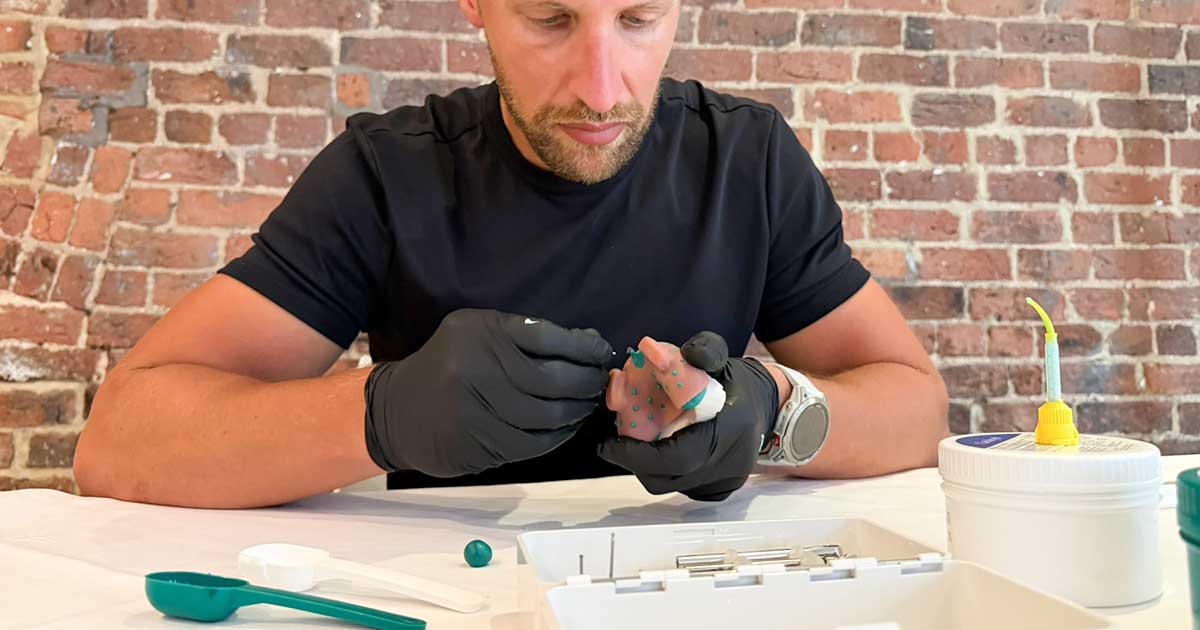
The one-day hands-on course covers the complete single implant restorative workflow, including case selection, components, scan bodies, conventional and digital impressions, crown fitting, torque protocols, radiographic verification, occlusion and maintenance.
7 hours verifiable CPD · Maximum 12 delegates · Hope Street Hotel, Liverpool
Clinical/regulatory note: This article provides general educational information rather than individual legal, indemnity or clinical advice. Clinicians should refer to current GDC guidance, their indemnity provider and relevant manufacturer instructions.