

Screw-Retained vs Cement-Retained Implant Crowns: What Dentists Need to Know

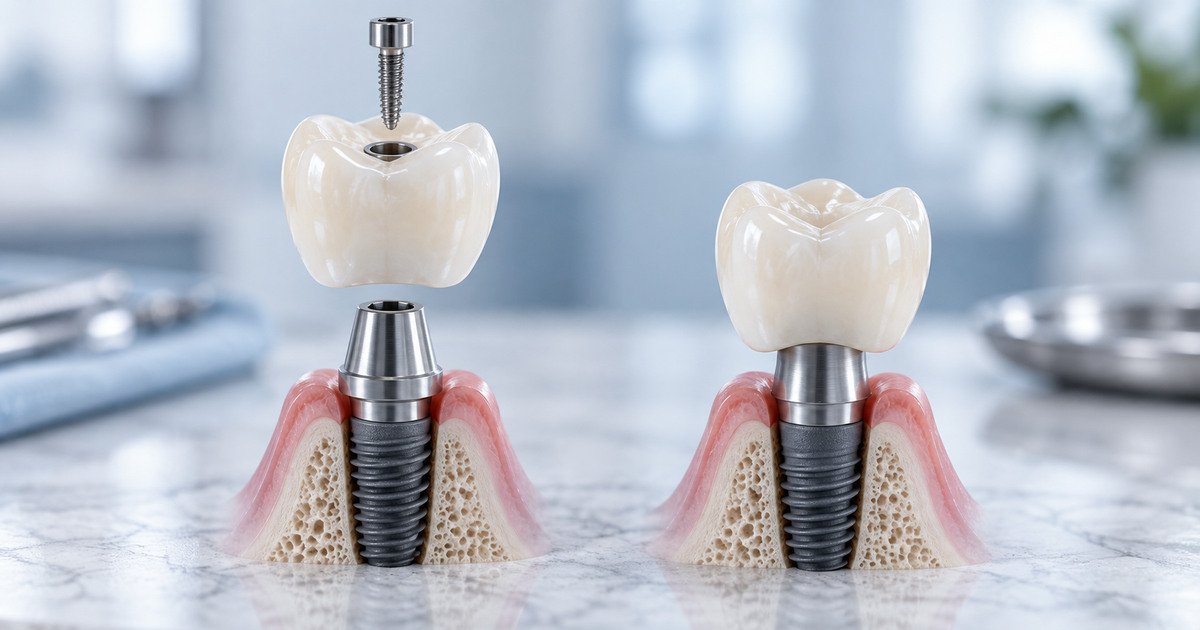
One of the first restorative decisions inimplant dentistry is how the crown will be retained. Should it screw directlyto the implant or abutment, or should it be cemented onto an abutment?
Both approaches can work successfully. Themore useful question is not “which is universally better?” but “which designbest fits this implant position, restorative space, access trajectory,aesthetic requirement and maintenance plan?”
For GDPs beginning implant restoration,understanding the practical consequences of each option is more important thanadopting a rigid rule.
What is a screw-retained implant crown?
A screw-retained crown is connected to theimplant or an intermediate abutment by a prosthetic screw. The screw-accesschannel passes through the restoration and is sealed after the crown istorqued.
Its major practical advantage isretrievability. If the restoration needs to be removed for maintenance, screwreplacement, repair or assessment of the implant, the access can usually bereopened without destroying the crown.
What is a cement-retained implant crown?
A cement-retained restoration uses animplant abutment as the prepared “tooth-like” foundation. The abutment issecured to the implant, and the crown is then cemented onto it.
This can be useful where the implanttrajectory would place a screw-access hole in an unacceptable position, orwhere restorative geometry favours a cemented solution. It introduces adifferent clinical responsibility: excess cement must be controlled and removedmeticulously.
The evidence does not support a simplistic winner
Systematic reviews have reported highsurvival with both screw-retained and cement-retained implant restorations. Thecomplication profiles differ, and the quality and heterogeneity of availableevidence mean the choice should be individualised rather than based on the ideathat one retention method is inherently superior in every case.
That is useful clinically. It allows therestorative design to be driven by the case rather than by dogma.
Why screw retention is often attractive for astraightforward single crown
Retrievability is particularly valuable inimplant dentistry because implant restorations may need maintenance over manyyears. A screw-retained design also avoids the risk of subgingival residualcement and gives the clinician direct control of the final prosthetic screwtorque.
For a well-positioned posterior implantwith an acceptable access trajectory, screw retention is therefore a verylogical option and is a useful workflow for GDPs to learn.
The limitations of screw retention
The access channel can compromiseaesthetics if it emerges facially or through an incisal edge. The channel alsooccupies restorative material and must be sealed in a way that allows futureretrieval.
Implant angulation matters. If the implanthas been placed without adequate restorative planning, a conventional screwchannel may emerge in an undesirable position. Angulated screw-channelsolutions may sometimes help, but they are system-specific and should beselected within manufacturer and laboratory parameters.
The advantages of cement retention
Cement retention can provide anuninterrupted occlusal or facial ceramic surface and may compensateprosthetically for an implant trajectory that is unsuitable for direct screwaccess.
It can also feel familiar to cliniciansaccustomed to conventional crown cementation. That familiarity should notobscure the differences between teeth and implants, particularly the difficultyof detecting and removing cement around a deep implant margin.
The main concern with cement: residual excess
Residual cement around implant restorationshas been associated with peri-implant inflammation. Risk is influenced bymargin position, cement type, soft-tissue anatomy, access and the cementationprotocol.
If a cemented restoration is selected, theabutment and crown should be designed to facilitate cement control. Deep,inaccessible subgingival margins should make you question whether the design isgenuinely the best option.
What about retrievability?
Implants and their restorations requirelong-term maintenance. Mechanical complications such as screw loosening,ceramic problems or component replacement can occur, while biological problemsmay also require access to the restoration.
A screw-retained crown is not automaticallyeasy to retrieve in every situation, but designing for retrievability from thestart usually gives the restorative team more options later.
A practical decision framework for GDPs
Ask: Where will the screw access emerge? Isthe restoration aesthetic-zone or posterior? Can excess cement be predictablycontrolled? Is prosthetic space adequate? Is the chosen component systemcompatible with the planned restoration? How easily could the restoration bemaintained or removed later?
Then discuss the design with the implantsurgeon and technician where appropriate. Retention is part of restorativelydriven planning, not merely a laboratory preference.
What should you learn first?
For dentists new to implant restoration, astraightforward posterior screw-retained single crown is an excellent workflowthrough which to learn component identification, crown seating, calibratedtorque, occlusal assessment and screw-access sealing.
Once those principles are understood,cement-retained and more complex designs are much easier to evaluatecritically.
Related Engage reading
· Related Engage guide: The Single Implant Crown workflow
Want to put this into practice?
On Engage One you will work through thecomplete fitting sequence for a screw-retained single implant crown, includingseating verification, torque, occlusion and access sealing.
Clinical note: This article provides general educational information for dental professionals. Implant components, tightening protocols, impression procedures and restorative workflows vary by manufacturer and clinical situation. Always work within your personal competence and indemnity, use current manufacturer instructions, and refer when appropriate.
References and further reading
· Sherif et al. A systematicreview of screw- versus cement-retained implant-supported fixed restorations — https://pubmed.ncbi.nlm.nih.gov/24382004/
· Wittneben et al. Screw retainedvs cement retained implant-supported fixed dental prosthesis — https://pubmed.ncbi.nlm.nih.gov/28000276/
· Sailer et al. Cemented andscrew-retained implant reconstructions: survival and complication rates — https://pubmed.ncbi.nlm.nih.gov/23062142/
· GDC Scope of Practice guidance— https://www.gdc-uk.org/standards-guidance/standards-and-guidance/scope-of-practice